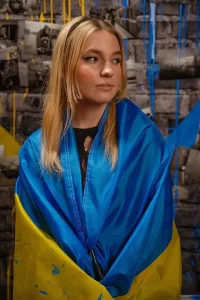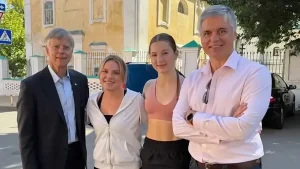
Ukrainian-American singer Kelsie Kimberlin releases her new single, “Champ,” today, accompanied by a music video. The release coincides with the fourth anniversary of the full-scale invasion of Ukraine, reinforcing the song’s political nature.
At 26, Kimberlin has forged a career characterized by a dual vocation: music and humanitarian work. From her childhood—when she participated in Yoko Ono’s Peace Project—to her recent productions alongside engineers and producers associated with figures like Adele and Amy Winehouse.
A hymn of overcoming adversity with a wartime backdrop
On a strictly lyrical level, “Champ” employs motivational rhetoric reinterpreted within a political context: “You’re a champion, they can never keep you down.” The lyrics utilize the sporting metaphor—leading the race, winning gold, staying on top—to translate it into the existential and, consequently, the social realm. It is not merely about individual competition, but about moral resistance against forces that seek to displace or silence us.
The repetition of “Get up” is the central idea: getting up is not just a physical action, but an ethical gesture. The production, by Vasyl Tkach, Pedro Vengoechea, and Brett Kimberlin, enhances this epic character with solid instrumentation (guitars, keyboards, bass, and drums) and a powerful sound thanks to Liam Nolan’s mixing and Stuart Hawkes’ mastering.
The competitive metaphor as a poetic structure
El eje conceptual gira en torno a la idea de liderazgo y permanencia en la cima:
Once you’re leader of the race
You never wanna be in second place
Once you’re winner of the gold
You always wanna be the champ again
It’s not about achieving victory, but about internalizing the champion’s status as a constitutive part of the self. The song suggests that triumph is not something eventual, but rather part of a state of consciousness, a way of life. In this sense, the champion is not just the athlete, but the individual who chooses not to relinquish their moral or existential position.
Everybody’s trying to replace you
Say you’ve been already at the top

This is where the external threat is introduced: the forces that attempt to displace, relativize, or invalidate previous achievements. In the social context of the song, “they” allows for a double interpretation:
- At an individual level: competition, social pressure.
- At a collective level: political aggression, attempted subjugation, symbolic erasure.
Ambiguity universalizes the message without losing its anchor in the Ukrainian context.
Once you get the taste of winning
You don’t ever wanna lose again
Here a psychological component comes into play: the memory of success as a form of resilience. Having been a champion once creates an internal standard that is impossible to abandon.
Taken together, “Champ” articulates a poetics of resistance through the sporting metaphor: the identity of a champion is an ethical choice in the face of adversity. Metaphorically, there is an individual motivation and an implicit political statement, transforming the language of sport into a discourse on dignity, persistence, and national affirmation.
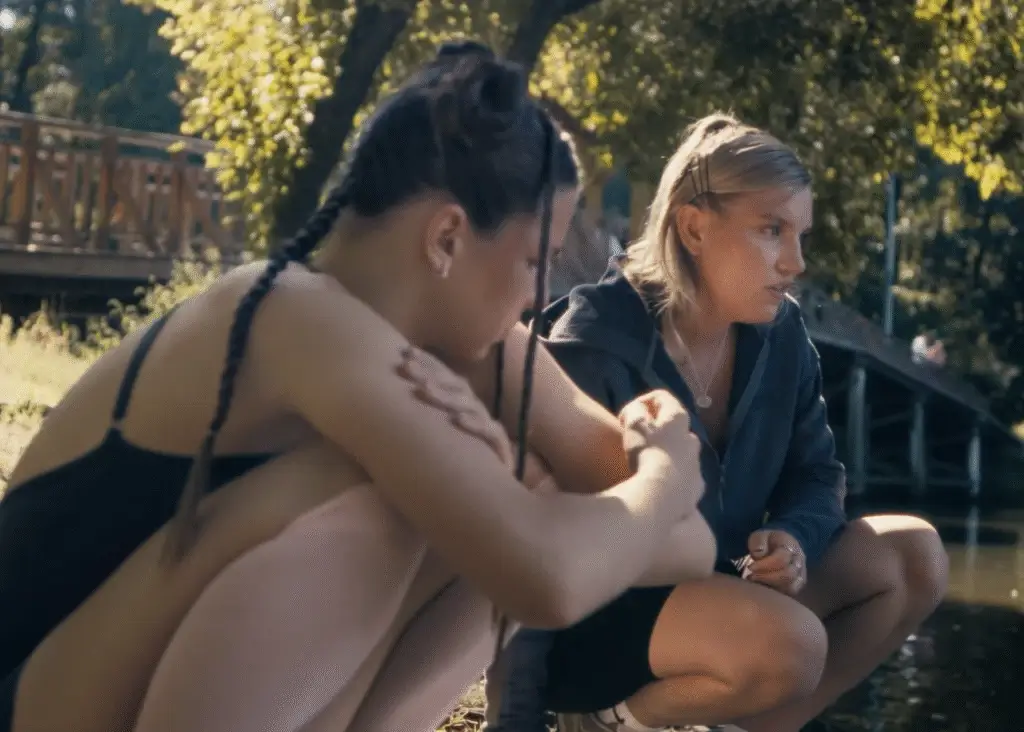
Mariia Hnes: the gesture that inspired the video
The music video incorporates a documentary dimension by featuring the young karate champion Mariia Hnes. In December 2024, during a competition in Vienna, the athlete—whose father serves in the Ukrainian Armed Forces—decided not to pose on the podium with a Russian competitor, even though both had won medals. Her decision to withdraw from the stage went viral and was celebrated as an act of national dignity.
Kimberlin traveled to Kyiv in September 2025 to film the video with Mariia, amidst some of the missile and drone attacks. The clip includes real footage of people taking shelter during an air raid, underscoring that “Champ” is not a distant allegory, but rather a direct reference to Ukraine’s social problems.

Music and activism
The release of “Champ” is also accompanied by a fundraising campaign to support the children of Ukrainian soldiers who participate in sports. The initiative is being coordinated through the website UkrainianChampions.com and will be managed by the artist’s foundation. The goal is to provide resources that will allow these young people to continue their athletic training in a context marked by war.
This is not the first time Kimberlin has integrated art and humanitarian action. In 2023, she filmed music videos in Bucha and Irpin—emblematic locations of the conflict—and subsequently received the United Nations Humanitarian Award and the Royal George Medal, awarded by King Charles III, for her support of Ukraine.
More than a single
“Champ” works on several levels: as a motivational song, as a war document, and as a fundraising tool. True champion status isn’t defined solely by the podium, but by the consistency between conviction and action.
Kelsie Kimberlin understands music not only as entertainment, but also as a platform for memory, protest, and hope. “Champ” is not only a great song, it is also a real-time cultural and social statement.
Source: https://www.revistasoundloop.com/2026/02/champ-kelsie-kimberlin.html